AI Answers
from your Company Data
with Citations
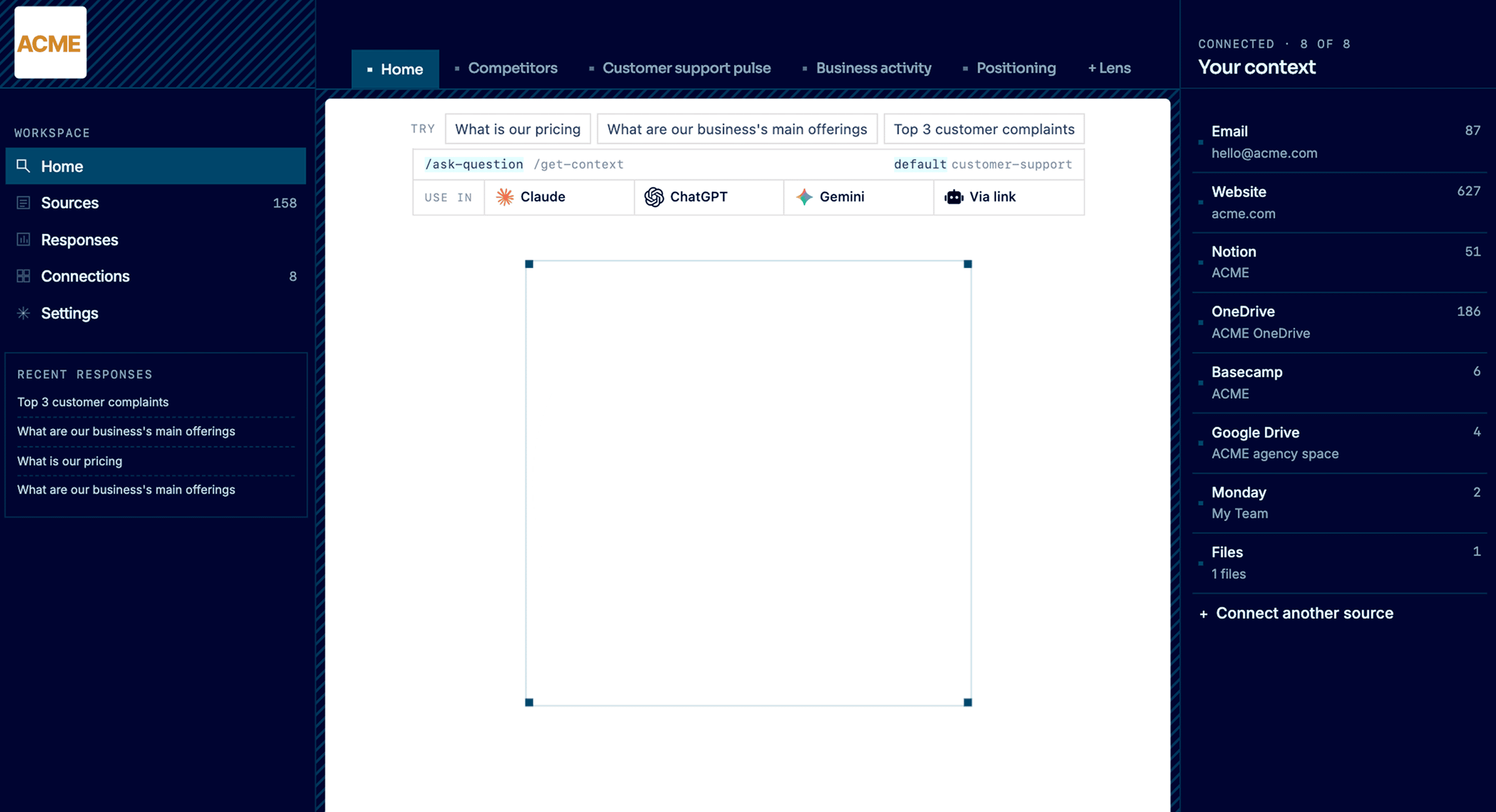
Ask Context Link a question from any AI chat. Get one grounded paragraph with numbered citations back to your Notion, Docs, email, Basecamp, and more.
*Start for free

The answer,
not the chunks
Get context on [topic] returns raw snippets for the AI to reason over. Ask Context Link goes one step further: one grounded paragraph that directly answers your question, ready to paste, quote, or skim.

Every claim
cited to the source
Numbered citations back each fact to a specific Notion doc, Google Doc, email thread, or web page. Click a [1] and jump straight to the original. No black-box answers.

No new chat UI
to learn
Ask Question runs inside Claude and ChatGPT as a skill. Type /ask-question what's our refund policy? in the AI tool you already use. No app to open, no new interface to learn.
works with:







 Basecamp






1. Connect
Plug in the places your business already exists.
Notion, Google Docs, websites, inboxes, files, project tools. Context Link keeps them all in sync as one connected knowledge base. Stop copy-pasting context into every AI prompt. Your business is already written down. It just needs to live somewhere AI can read.
2. Ask
Ask your business anything.
Get source-backed answers across everything you've connected: pricing, positioning, support patterns, customer signal, competitor moves. A vector database under the hood means AI searches by meaning, not just keywords. Your team asks from the dashboard. Claude, ChatGPT, and any MCP-aware agent ask through the integrations. Every answer cites where it came from.
3. Observe
See your business like never before.
Lenses are live, source-backed views: competitors, customer support pulse, positioning, business activity. Each one combines your connected sources with recurring AI deep research to answer: what's true right now, what changed, and what needs attention. Every result is backed by evidence in the right-hand column, so you can see why things are the way they are.
4. Evolve
Move the business where you want it to go.
Pick a goal for a Lens: go upmarket, tighten your ICP, refresh positioning. Context Link briefs an AI on everything that matters: your sources, your Lens, your history. The goal becomes concrete next actions you can copy, open in any AI tool, or run yourself.
features
Direct answers with receipts
Invoke /ask-question from Claude or ChatGPT. The same semantic search runs across your connected sources, then a small fast LLM composes one grounded paragraph with numbered citations. Every claim is traceable back to the source it came from.

features
Runs inside the AI you already use
Glean, Moveworks, Amazon Q, and Dropbox Dash lock you into their own chat interface. Ask Question is a Claude skill and ChatGPT connector, so you stay in the AI tool you already use and get cited answers in the same conversation.
features
Searches your whole stack, not one source at a time
Connect Google Docs and Drive, OneDrive, Notion, Basecamp, Monday.com, websites, file stacks (PDFs, Word, Markdown), and email inboxes (Gmail, Outlook, Zoho, Fastmail, IMAP). Ask Question searches them all in a single query.

features
Grounded, it won't invent facts
The synthesis LLM is instructed to ground every claim in the retrieved snippets. If your sources don't cover the question, the answer says so rather than making something up. Numbered citations mean you can always verify, fast.
See Ask Question in Claude
 Ask Question
· Claude
Grounded Answer
· Claude
Ask Question
· Claude
Grounded Answer
· Claude
Industries
Context Link works with your kind of business.
Add Context Link to your computer or phone so business context is never more than a click away.

See your e-commerce business as a set of live views: who you're really competing with, what customers keep contacting support about, how your brand is actually landing. Each one is source-backed and updates as the business moves, not a quarterly guess. It runs on what you already have: connect the support inbox, brand book, catalogue and help centre, and the picture stays current on its own.

See your software business from every angle: your positioning, your competitive set, the marketing channels actually working. Live, source-backed views that tell you what's true now and what changed, so you know before the next launch, not after. It builds from the docs you already keep, like specs, changelogs, interviews and support threads, read where they live so the view never goes stale.
See the studio the way the outside world does: a live read on how your positioning actually comes across, not how you hope it does. Source-backed, and grounded in your own back-catalogue of briefs, case studies, brand books and project archives, so strategy stops half-remembering and starts citing, and every pitch stands on the studio's real history.

See your business from every angle: positioning, competitors, customer support and more, as live, source-backed views that tell you what's true right now, what changed, and what needs attention. They build from the places the business already lives, like docs, sites, inboxes and files, so the view stays current without anyone maintaining it. Your business stops being something you re-explain, and becomes something you can watch and talk to.
Workflows
Ask from inside the AI tools you already use
Type /ask-question what's our refund policy for annual plans? in Claude or ChatGPT. Context Link runs semantic search across your connected sources (Notion, Google Docs, email threads, websites), then routes the results through a small fast LLM for synthesis.
Workflows
One paragraph, numbered citations
The answer comes back with [1], [2], [3] markers clicking straight through to the Notion doc, Google Doc, email thread, or web page it pulled from. No parsing chunks. No reconciling three docs mid-reply. One grounded paragraph, ready to act on.

Workflows
Review and control from the Context Link app
See every question your AI has asked, which sources it pulled from, and tune your connections and Modes to improve future answers. Beyond ad-hoc questions, observe Lenses on positioning, competitors, and customer support pulse to see what's changing across your business, kept current by recurring AI deep research. Pro includes 1,000 LLM requests per month, shared across all LLM-powered features.

Share context across your team
Stop pasting the same docs into every chat. Share one link, and your team's AIs can pull the latest context from your connected sources—consistently, every time.

(ChatGPT)
(Claude)

agent 004
session




 +
+
+
+
+
+
Frequently Asked Questions
What's the difference between Get Context and Ask Question?
Two skills, two outcomes. "Get context on [topic]" runs a semantic search across your connected sources and returns the raw matching snippets in markdown, ideal when the AI needs source material to reason over. "/ask-question [question]" (or "ask Context Link what...") runs the same retrieval under the hood, but a small fast LLM composes one grounded paragraph with numbered citations. Get Context is the primary workflow; Ask Question is a secondary sub-mode for when you want the direct answer, not the source material.
Can Ask Question make up facts that aren't in my sources?
The synthesis LLM is instructed to ground every claim in the retrieved snippets and cite them with [1], [2] markers. If your sources don't cover the question, the answer will say so rather than invent something. Every citation clicks through to the actual source doc, so you can always verify.
What sources can Ask Question search?
All of them, in a single query: Google Docs and Drive, OneDrive, Notion, Basecamp, Monday.com, any website (via sitemap or URL list), named file stacks (PDFs, Word, Markdown), and email inboxes and folders (Gmail, Outlook, Zoho, Fastmail, and custom domains via IMAP). You don't have to guess which tool the answer lives in, Ask Question searches everything you've connected and synthesises one grounded paragraph.
How is this different from Glean, Moveworks, or Amazon Q?
Those tools are capable, but they're their own chat interface, you have to switch apps to ask a question, then copy the answer back into ChatGPT or Claude if that's where your real work happens. Ask Question runs inside Claude and ChatGPT as a skill, so you stay in the AI tool you already use. Numbered citations click through to the real source (Notion, Google Docs, email thread) rather than a summarised excerpt inside a walled garden.
Is Ask Question available on the free plan?
Ask Question is a Pro feature. Pro includes 1,000 LLM requests per month, shared across all LLM-powered features. Starter accounts see an upgrade prompt when they hit Ask Question endpoints. Regular Get Context retrieval, the primary workflow, has no such gating and is available on all plans.