AI content that knows
your business
Connect your website, Notion, and Google Docs once. Ask from inside the AI you already use, and get blog posts, SEO pages, and marketing copy grounded in your real sources, with citations.
*Start for free

Ask from inside
the AI you write in
Get context on brand voice, claims, or pricing without leaving Claude or ChatGPT. Source-backed snippets, with citations, before any draft.

SEO pages that
stay consistent
Publishing at scale? Pull from canonical definitions, product claims, and existing content so facts don't drift across hundreds of pages.

Blog posts grounded
in real sources
AI searches your connected docs and website before writing. No more hallucinated details or invented claims about your company.
works with:







 Basecamp






1. Connect
Plug in the places your business already exists.
Notion, Google Docs, websites, inboxes, files, project tools. Context Link keeps them all in sync as one connected knowledge base. Stop copy-pasting context into every AI prompt. Your business is already written down. It just needs to live somewhere AI can read.
2. Ask
Ask your business anything.
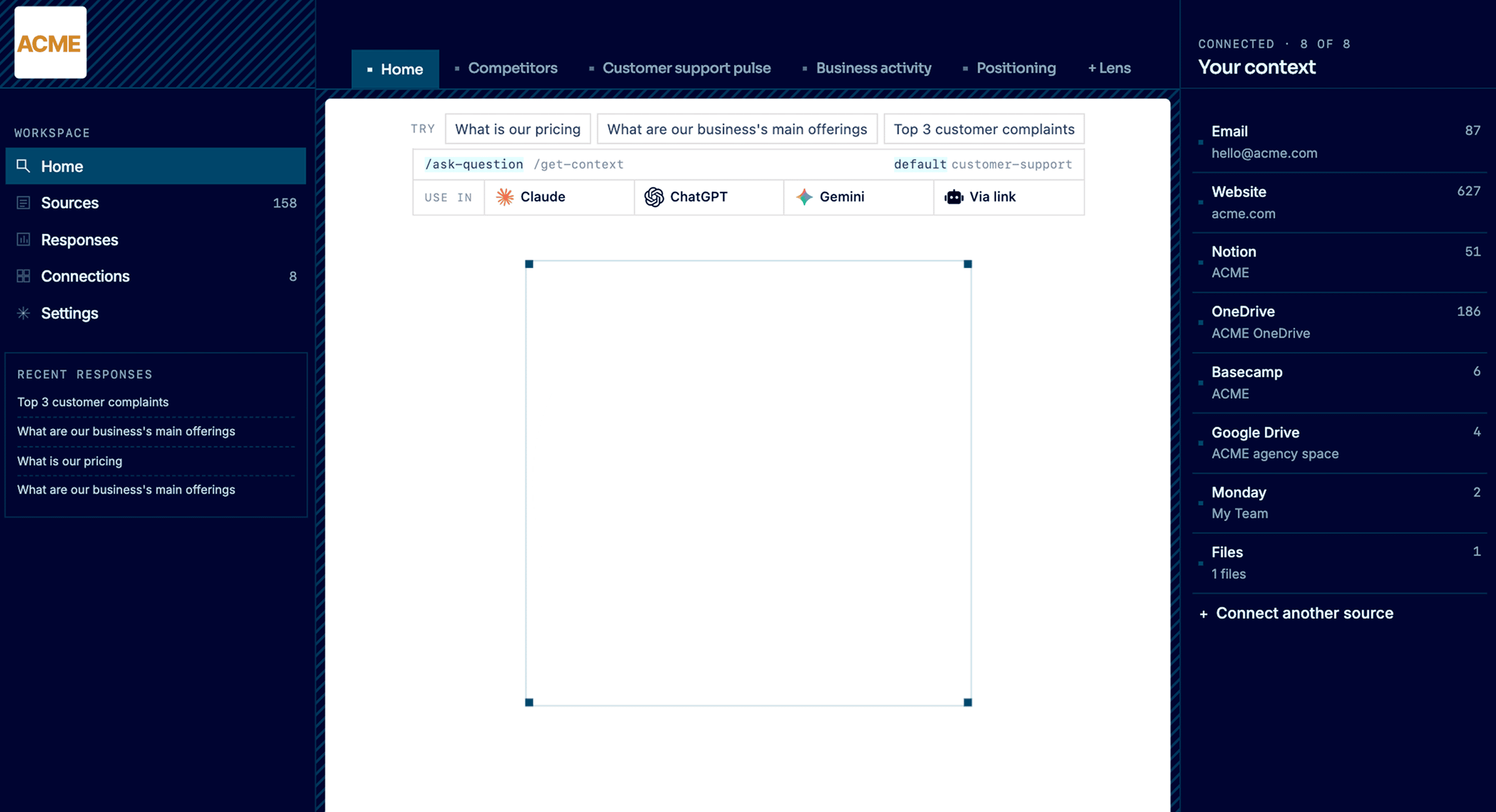
Get source-backed answers across everything you've connected: pricing, positioning, support patterns, customer signal, competitor moves. A vector database under the hood means AI searches by meaning, not just keywords. Your team asks from the dashboard. Claude, ChatGPT, and any MCP-aware agent ask through the integrations. Every answer cites where it came from.
3. Observe
See your business like never before.
Lenses are live, source-backed views: competitors, customer support pulse, positioning, business activity. Each one combines your connected sources with recurring AI deep research to answer: what's true right now, what changed, and what needs attention. Every result is backed by evidence in the right-hand column, so you can see why things are the way they are.
4. Evolve
Move the business where you want it to go.
Pick a goal for a Lens: go upmarket, tighten your ICP, refresh positioning. Context Link briefs an AI on everything that matters: your sources, your Lens, your history. The goal becomes concrete next actions you can copy, open in any AI tool, or run yourself.
features
Connect your content sources
Link your website, Notion workspace, Google Docs, and any project tool the team uses. Context Link keeps them in sync as one connected knowledge base. Your existing content becomes the foundation for every AI-generated draft.

features
Search your content before writing
Ask AI to 'get context on X' from inside Claude or ChatGPT, and get the exact passages from your docs and published pages. Need a single fact mid-draft? Invoke /ask-question for a grounded, cited paragraph in one shot.
features
Positioning Lens keeps messaging coherent
A Positioning Lens surfaces what your product says it is right now, what changed, and where the story is drifting between channels. Combine your sources with recurring AI deep research and catch inconsistencies before they ship.
features
Scale content without drift
Whether you're publishing 10 pages or 1,000, AI pulls from the same connected sources. Definitions stay consistent, facts don't diverge, and your editorial team spends less time fixing mistakes.
Integrates with the AI you already use
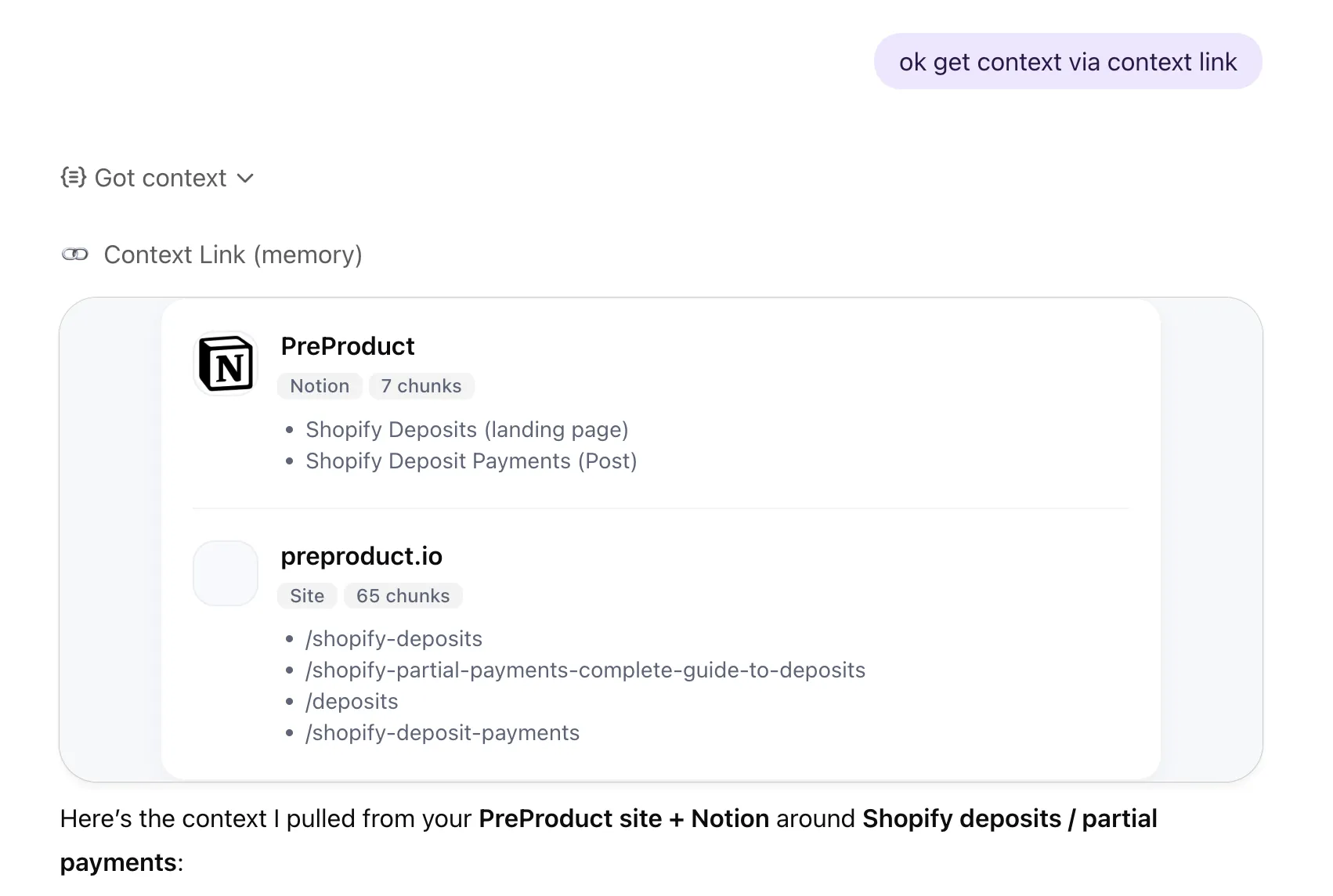
 Get Context
· ChatGPT
Get Context
· ChatGPT
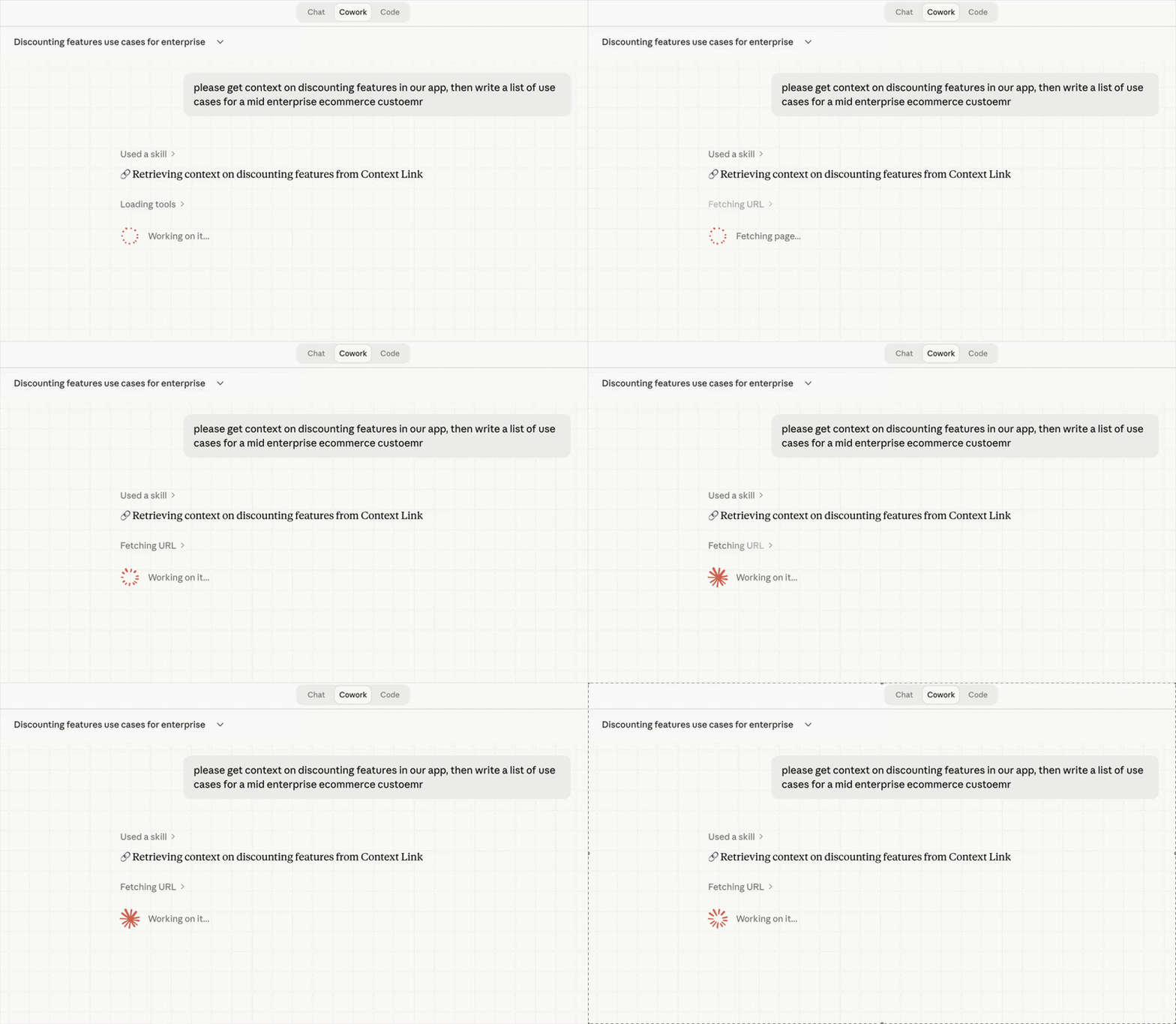
 Get Context
· Claude
Get Context
· Claude
Industries
Context Link works with your kind of business.
Add Context Link to your computer or phone so business context is never more than a click away.

See your e-commerce business as a set of live views: who you're really competing with, what customers keep contacting support about, how your brand is actually landing. Each one is source-backed and updates as the business moves, not a quarterly guess. It runs on what you already have: connect the support inbox, brand book, catalogue and help centre, and the picture stays current on its own.

See your software business from every angle: your positioning, your competitive set, the marketing channels actually working. Live, source-backed views that tell you what's true now and what changed, so you know before the next launch, not after. It builds from the docs you already keep, like specs, changelogs, interviews and support threads, read where they live so the view never goes stale.
See the studio the way the outside world does: a live read on how your positioning actually comes across, not how you hope it does. Source-backed, and grounded in your own back-catalogue of briefs, case studies, brand books and project archives, so strategy stops half-remembering and starts citing, and every pitch stands on the studio's real history.

See your business from every angle: positioning, competitors, customer support and more, as live, source-backed views that tell you what's true right now, what changed, and what needs attention. They build from the places the business already lives, like docs, sites, inboxes and files, so the view stays current without anyone maintaining it. Your business stops being something you re-explain, and becomes something you can watch and talk to.
Workflows
See which sources informed each draft
Every AI response logs the content it retrieved. Review which docs and pages were used, spot gaps in your source material, and improve context over time.
Workflows
Control what AI can reference
Choose exactly which Notion pages, Google Docs, and website sections to include. Keep internal-only docs separate from public content. Add or remove sources anytime.
Scale with your org
Perfect context for every role
Context Link supports organisation-wide sources alongside user-specific ones, so everyone starts with a shared foundation. Take it further with Modes: named profiles like 'support' or 'sales' that re-weight your knowledge base for each use case. For example, boost your help centre and docs for customer support, then your blog and Notion for marketing. Same knowledge base, different lens.
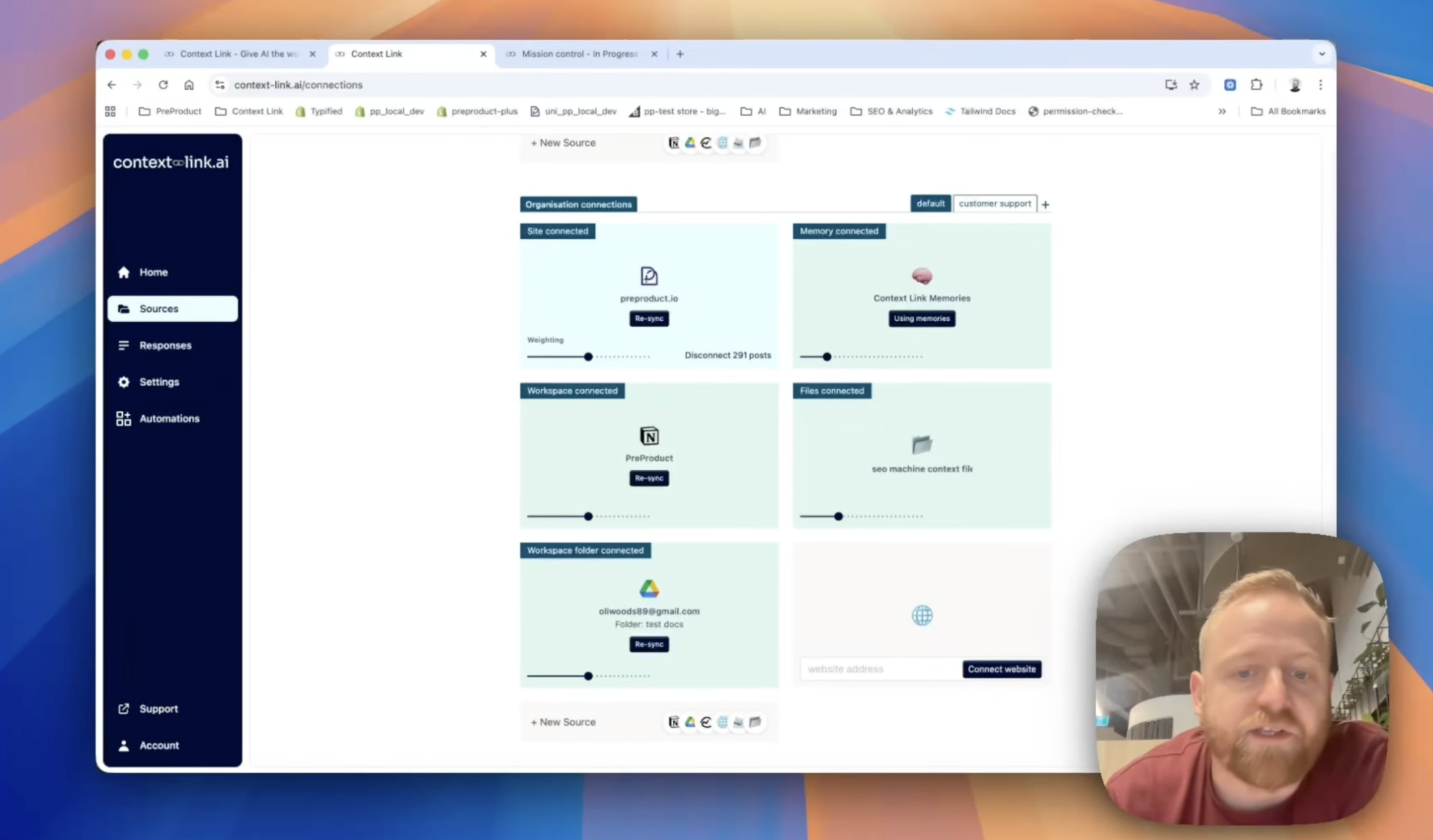
Share context across your team
Stop pasting the same docs into every chat. Share one link, and your team's AIs can pull the latest context from your connected sources—consistently, every time.
(ChatGPT)
(Claude)

agent 004
session




 +
+
+
+
+
+
Frequently Asked Questions
How does Context Link improve AI content creation?
Context Link gives AI a virtual version of your business before it writes. Connect your website, docs, and brand guidelines once, then ask from inside ChatGPT or Claude. AI retrieves the right snippets by meaning, with citations, so every draft is grounded in your real source material instead of generic output or invented claims.
Can I use this with ChatGPT or Claude?
Yes. Context Link works with ChatGPT (via the official app connector), Claude, Gemini, and any MCP-aware agent. Connect your sources once, then use whichever AI your team prefers. The same connected knowledge base serves all of them.
How do I keep brand voice consistent across content?
Connect your brand voice doc, style guide, and messaging frameworks as sources. AI retrieves them before any writing task, so drafts match your tone without re-explaining. A Positioning Lens surfaces drift between channels, so the website, deck, and recent posts stay aligned as the story evolves.
Is this different from uploading files to ChatGPT?
Yes. File uploads are one-off and limited to a single conversation. Context Link connects your sources permanently, keeps them synced, and makes them searchable across all your AI tools. You connect once instead of re-uploading before every task.
What content sources can I connect?
Context Link supports Notion workspaces, Google Docs and Drive, websites (via sitemap or URL list), uploaded files, email inboxes, Basecamp, and Monday. Most teams connect their published site, internal docs, and key reference materials. You choose exactly what to include.
Can I ask a direct question and get a grounded answer?
Yes. Alongside "get context on [topic]", Context Link has an Ask Question skill invoked as /ask-question [question] (or natural language: "ask Context Link what our refund policy is"). It runs the same semantic retrieval, then composes one concise paragraph with numbered citations back to the exact snippets used. Ask Question is available on Pro plans and counts toward the monthly LLM allowance (1,000 requests/month, shared across LLM-powered features).